

Iran, with its ancient Persian heritage, has historically been a pivotal crossroads of civilization, connecting East and West through the legendary Silk Road. In the 21st century, the concept of a “New Silk Road” or “Belt and Road Initiative” (BRI) has re-emerged as a dominant geopolitical and economic theme. For Iran, strategically positioned at the heart of this ambition, leveraging international law is not merely an option but a critical imperative to reclaim its historic role and unlock unprecedented economic potential.
The challenge, of course, lies in navigating a complex web of international sanctions, political tensions, and a skeptical global financial system. However, a meticulously crafted legal strategy, centered on existing and evolving international frameworks, can pave the way for Iran to rebuild its modern Silk Road, transforming it from a sanctioned outlier into an indispensable transit hub.
1. The Geopolitical Imperative: Iran as the Ultimate Land Bridge
Geographically, Iran is an unparalleled land bridge. It offers the shortest and most direct route for goods, energy, and digital traffic between:
- Europe and South Asia: Through the International North-South Transport Corridor (INSTC).
- The Caucasus and the Persian Gulf: Connecting Russia and the Caspian states to warm-water ports.
- Central Asia and the Indian Ocean: Providing landlocked nations vital access to global maritime trade.
Ignoring Iran means longer, more expensive, and less secure routes, forcing global trade to circumvent a natural geographical conduit. This inherent value provides a strong basis for arguing for Iran’s inclusion in major transit projects under international legal frameworks designed for trade facilitation.
2. Leveraging Multilateral Trade and Transit Agreements
Existing international instruments offer a foundation for Iran to assert its role:
- The TIR Convention (Customs Convention on the International Transport of Goods under Cover of TIR Carnets): Iran is a signatory to the TIR Convention. This UN-sponsored agreement facilitates international road transport by simplifying customs procedures at borders. By rigorously adhering to and promoting TIR, Iran can demonstrate its commitment to transparent and efficient transit, encouraging greater uptake by international haulers. Expanding the use of e-TIR (electronic TIR) can further enhance efficiency and security.
- The Almaty Programme of Action (APoA) and the Vienna Programme of Action (VPoA): These UN frameworks specifically address the needs of landlocked developing countries (LLDCs) for transit access. As a key transit country, Iran can invoke these programs to build consensus and legal obligations around facilitating trade for its landlocked neighbors (e.g., Afghanistan, Turkmenistan). This shifts the narrative from Iran seeking economic gain to Iran fulfilling an international responsibility to support regional development.
- Bilateral and Regional Transit Agreements: Iran has numerous bilateral and trilateral transit agreements with neighboring countries (e.g., Afghanistan, Pakistan, Turkey, Azerbaijan, Armenia). Strengthening these agreements, ensuring their full implementation, and standardizing procedures in line with international best practices (e.g., harmonized customs duties, single-window clearance) can create a legally robust and predictable transit environment. The ECO (Economic Cooperation Organization) Transit Trade Agreement is a prime example that can be revitalized.
3. Navigating Sanctions Regimes: Humanitarian Corridors and “Derisking”
The elephant in the room remains international sanctions, primarily from the U.S. and the UN (post-snapback). Addressing these requires a multi-pronged legal approach:
- Humanitarian Exemptions: While often challenging to operationalize, the legal carve-outs for humanitarian aid (food, medicine, agricultural goods) can be expanded. Iran can advocate for clear, legally binding international protocols for swift and secure transit of such goods through its territory, particularly for nations in crisis (e.g., Afghanistan). This builds a legal precedent for essential transit that can be expanded to other “low-risk” goods.
- Legal Challenges and Advocacy: Iran, potentially with the backing of non-Western allies, can pursue legal challenges against the extraterritorial application of certain unilateral sanctions in international courts, arguing their interference with customary international law concerning freedom of transit and sovereignty over national resources. While outcomes are uncertain, such actions force a global legal debate.
- “Derisking” Strategies via International Financial Institutions (IFIs): Although direct IFI funding is constrained by sanctions, Iran can work with international legal experts to develop “derisking” mechanisms. This might involve setting up escrow accounts, special purpose vehicles, or leveraging national development banks from non-sanctioning countries (e.g., China, Russia, India) to finance transit infrastructure projects. Structuring these investments to comply with international anti-money laundering (AML) and counter-terrorism financing (CTF) standards, potentially through UN-supervised mechanisms, can mitigate risk.
4. Investing in Digital Silk Road Infrastructure and Cyber Law
The modern Silk Road is not just about physical goods; it’s about data. Iran’s legal framework for digital infrastructure is crucial:
- International Telecommunication Regulations (ITRs) and Cyber Law: Iran needs to align its cyber laws and data transit regulations with international norms, ensuring robust data protection, privacy, and non-discriminatory access. Building state-of-the-art fiber optic networks and legally secure data centers can position Iran as a critical digital hub, much like it was for physical goods. Adherence to international standards for internet governance and cyber security will be key.
- Intellectual Property Rights (IPR): Protecting IPR for technologies transiting or developed within Iran is essential to attract high-value digital investments. Strengthening its legal framework for IPR, in line with treaties like the TRIPS Agreement, signals a commitment to global standards.
5. Cultivating Legal Certainty and Predictability
Ultimately, the success of Iran’s Silk Road ambitions hinges on creating a legal environment that inspires confidence. This means:
- Transparency and Rule of Law: Businesses, logistics firms, and investors demand predictable legal frameworks, fair judicial processes, and transparent regulations. Reforms that strengthen the rule of law within Iran and streamline bureaucratic processes are paramount.
- Dispute Resolution Mechanisms: Establishing accessible and impartial international arbitration mechanisms for commercial disputes related to transit projects would significantly reduce perceived risks for foreign investors.
- Engagement with International Organizations: Proactive engagement with UNCTAD (UN Conference on Trade and Development), UNECE (UN Economic Commission for Europe), and other bodies focused on trade and transport facilitation can help Iran align its domestic legal and regulatory frameworks with international best practices.
Conclusion
Iran’s aspiration to rebuild its Silk Road is not merely an economic dream; it is a geopolitical necessity rooted in its unique geography and historical legacy. By meticulously deploying existing international laws, advocating for new frameworks, strategically navigating sanctions, and building a robust, transparent legal infrastructure, Iran can transform itself into an indispensable artery of global trade and connectivity. The journey will be arduous, requiring persistent diplomatic effort, internal reforms, and a commitment to international norms, but the potential rewards—economic prosperity, regional stability, and renewed global influence—make it a choice worth pursuing with the full force of international law.
-
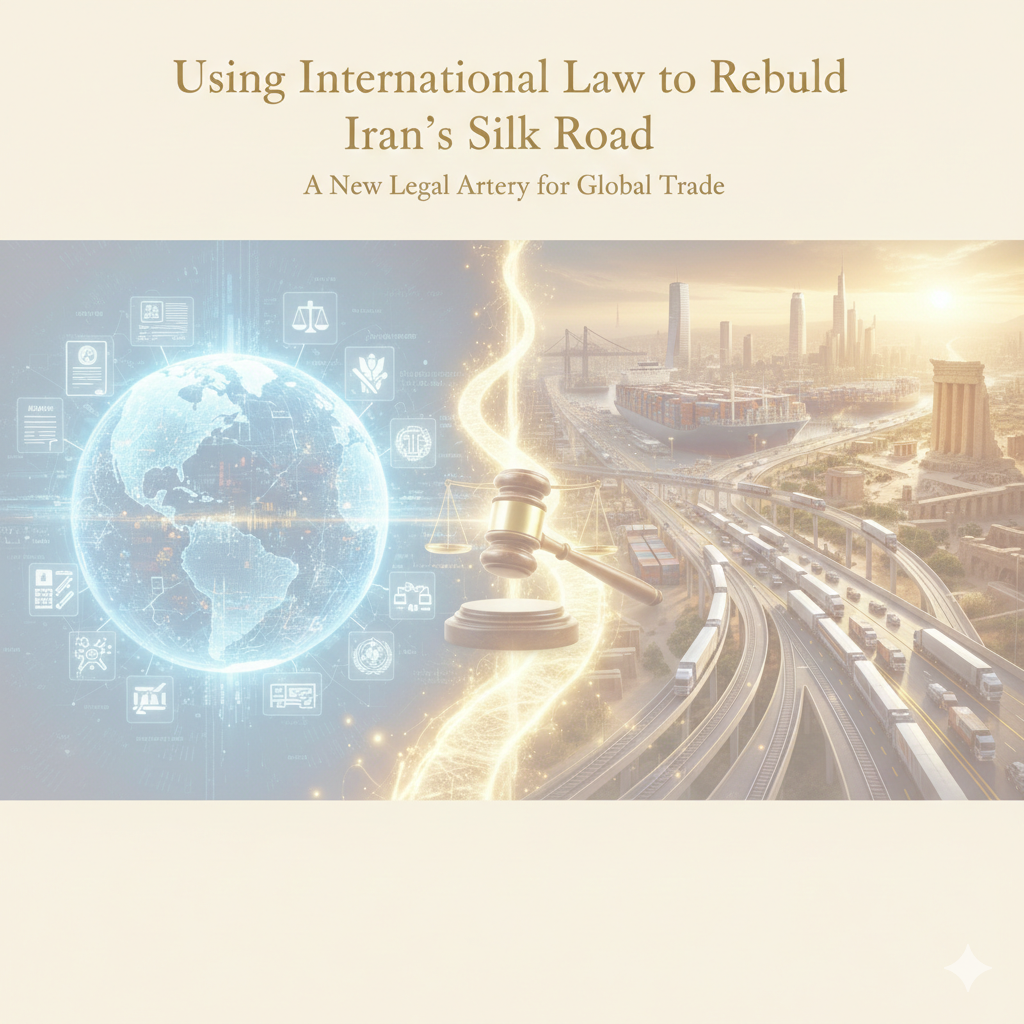
Using International Law to Rebuild Iran’s Silk Road
Iran, with its ancient Persian heritage, has historically been a pivotal crossroads of civilization, connecting…
-

Iran’s Rich Choice: Abraham Accords or Cyrus Accords
The geopolitical chessboard of the Middle East is in perpetual flux, but rarely does a…
-

UN Sanctions and the Collapse of the JCPOA (2026)
As of February 2026, the international community has witnessed the most significant shift in global…